
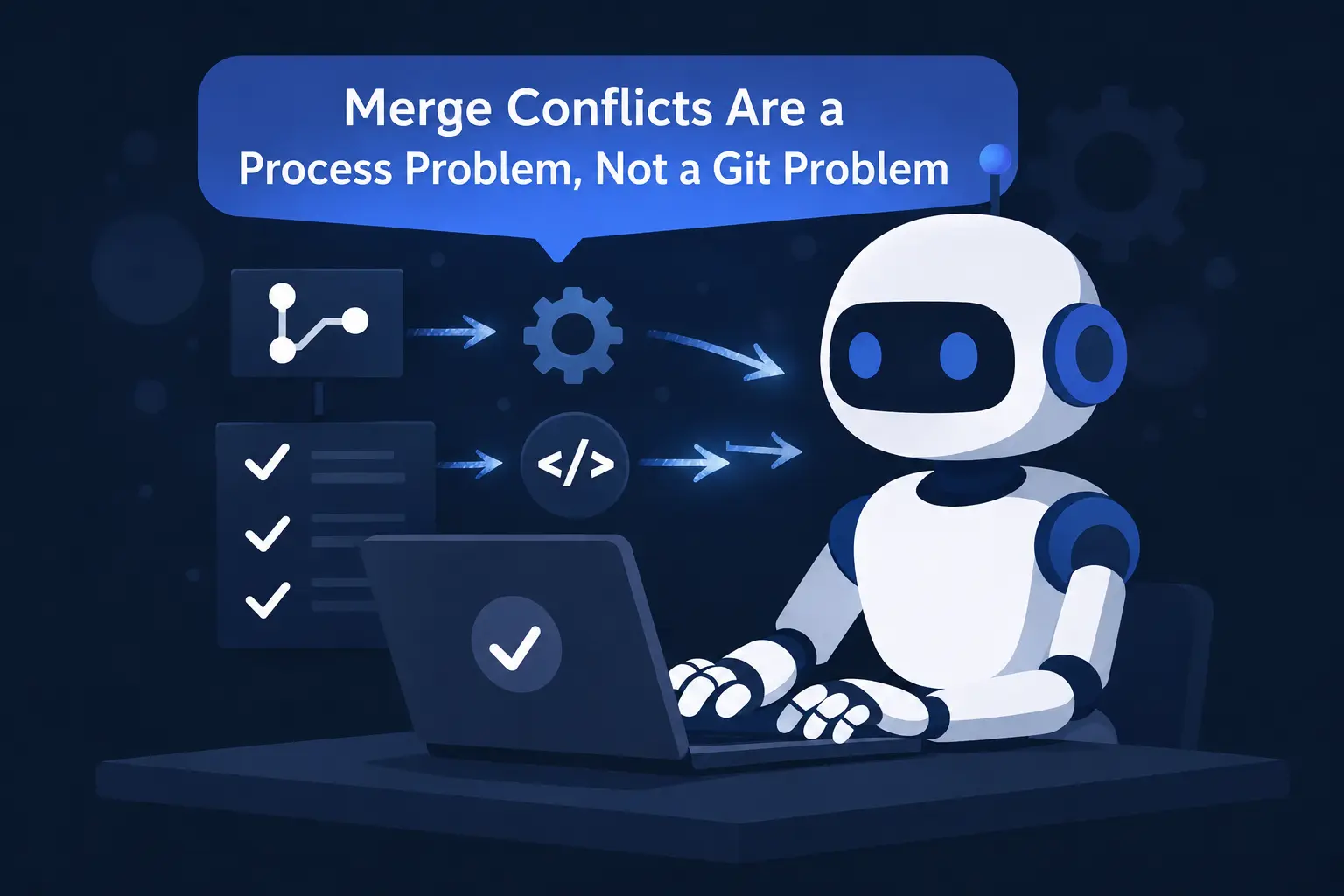
Most developers treat merge conflicts as a Git problem.
Git tells you that two people changed the same code, highlights the conflicting lines, and leaves you to sort it out. After a few minutes of editing, you commit the resolution and move on.
It feels like Git is the problem.
But after working on enough backend projects, I’ve come to a different conclusion.
Merge conflicts are rarely caused by Git itself.
Git is simply exposing a problem that already exists in your development process.
If your team spends hours every week resolving merge conflicts, the real issue probably isn’t your version control system. It’s how your team works.
Last article in this category: https://codecraftdiary.com/2026/06/28/automated-testing-strategies-for-trunk-based-development-how-to-build-a-10-minute-pipeline/
Git Isn’t Creating the Conflict
One thing that’s easy to forget is that Git doesn’t invent conflicts.
A merge conflict only appears when Git genuinely cannot determine which change should win.
Imagine two developers working on the same controller.
Developer A adds request validation.
Developer B changes the response format.
Both modify the same method.
Git stops and asks someone to make the decision because it simply doesn’t have enough context.
That’s exactly what it’s supposed to do.
The conflict isn’t a Git failure.
The failure happened much earlier—when two developers unknowingly spent days modifying the same piece of code.
The Real Question Is: Why Did This Happen?
Whenever someone tells me:
“Git merge conflicts are driving me crazy.”
I usually ask one question.
How long was your branch open?
More often than not, the answer is:
- four days
- one week
- sometimes even three weeks
That’s usually where the real problem begins.
Every day your branch stays isolated, the main branch keeps moving.
Someone renames classes.
Someone refactors a service.
Someone fixes a production bug.
Someone updates dependencies.
By the time you’re ready to merge, your code is no longer based on today’s project—it’s based on the project from last week.
Git is simply the first tool to point that out.
The Hidden Cost Isn’t the Conflict
People often think merge conflicts are expensive because they take time to resolve.
In reality, editing the conflicting lines usually takes only a few minutes.
Understanding why the conflict exists is what costs time.
Imagine this situation.
You started a feature on Monday.
By Friday:
- six pull requests have been merged
- your service has been partially refactored
- another developer extracted shared logic into a new class
- someone fixed a production bug in the same module
Now Git reports a conflict.
You’re no longer solving one conflict.
You’re rebuilding your mental model of everything that happened while you were working.
That’s the expensive part.
Large Pull Requests Multiply the Problem
One pattern appears almost everywhere.
Large pull requests almost always create larger merge conflicts.
It isn’t surprising.
A pull request with 2,000 changed lines touches dozens of files.
A pull request with 150 lines might touch only two or three.
Which one is more likely to overlap with someone else’s work?
Exactly.
This is one of the biggest reasons I prefer small pull requests.
Smaller changes don’t just make reviews easier.
They dramatically reduce the chance that multiple developers modify the same code at the same time.
Long-Lived Branches Drift Away From Reality
Feature branches aren’t the problem.
Long-lived feature branches are.
I’ve seen teams spend two weeks building a feature before opening their first pull request.
By then, the main branch has evolved so much that merging becomes an entire task on its own.
Developers spend hours:
- fixing conflicts
- updating failing tests
- adapting to refactored services
- resolving dependency changes
Ironically, teams often conclude that merging is painful.
The truth is slightly different.
Merging became painful because they waited too long.
Communication Prevents More Conflicts Than Git Ever Will
Not every conflict can be avoided.
Sometimes two developers genuinely need to work in the same part of the application.
The difference is whether they know about each other.
Imagine this.
One developer is refactoring the authentication service.
Another developer is implementing passwordless login.
Without communication, both spend several days modifying the same code.
The conflict is inevitable.
Now imagine a five-minute conversation before they start.
“I’m working on AuthService this week.”
“Me too.”
“Let’s split the work and merge more often.”
Five minutes of communication can save hours of unnecessary conflict resolution.
Git could never solve that problem.
Trunk-Based Development Changes Everything
This is one of the biggest reasons I’m such a fan of Trunk-Based Development.
The goal isn’t to eliminate merge conflicts completely.
That’s impossible.
The goal is to make them so small that nobody really cares.
Instead of merging once every Friday…
…developers merge several times every day.
Instead of resolving fifty conflicts at once…
…they resolve one tiny overlap before lunch.
Small branches create small pull requests.
Small pull requests create small conflicts.
Small conflicts rarely interrupt development.
The Most Dangerous Conflicts Never Appear in Git
Interestingly, the worst conflicts aren’t merge conflicts at all.
Imagine this scenario.
Developer A changes how discounts are calculated.
Developer B changes invoice generation.
Different files.
No merge conflict.
Everything merges perfectly.
Production breaks because invoice generation still expects the previous discount logic.
Git couldn’t detect that.
The problem wasn’t textual.
It was logical.
These hidden conflicts become much easier to discover when teams integrate continuously instead of waiting days before merging.
How to Reduce Merge Conflicts
No workflow eliminates merge conflicts completely.
But a few simple habits make them significantly less painful.
- Merge into the main branch frequently.
- Keep pull requests small.
- Avoid combining unrelated changes.
- Communicate when multiple developers work in the same area.
- Use feature flags instead of long-lived branches.
- Review pull requests quickly so they don’t sit idle for days.
None of these practices are revolutionary.
Together, however, they change merge conflicts from major interruptions into minor inconveniences.
Stop Blaming Git
Git has become one of the easiest tools to blame.
It reports the conflict.
It highlights the differences.
It forces developers to make a decision.
But Git didn’t create the problem.
It simply revealed it.
The next time your team spends an afternoon resolving merge conflicts, don’t ask:
“How can we get better at Git?”
Ask something much more valuable:
“What in our development process allowed this conflict to grow this large?”
Most of the time, the answer isn’t hidden in a Git command.
It’s hidden in the workflow.
And once the workflow improves, merge conflicts become exactly what they should be: small, occasional interruptions instead of recurring team-wide headaches.
Good observations. Pull daily and check PR requests daily.
good