
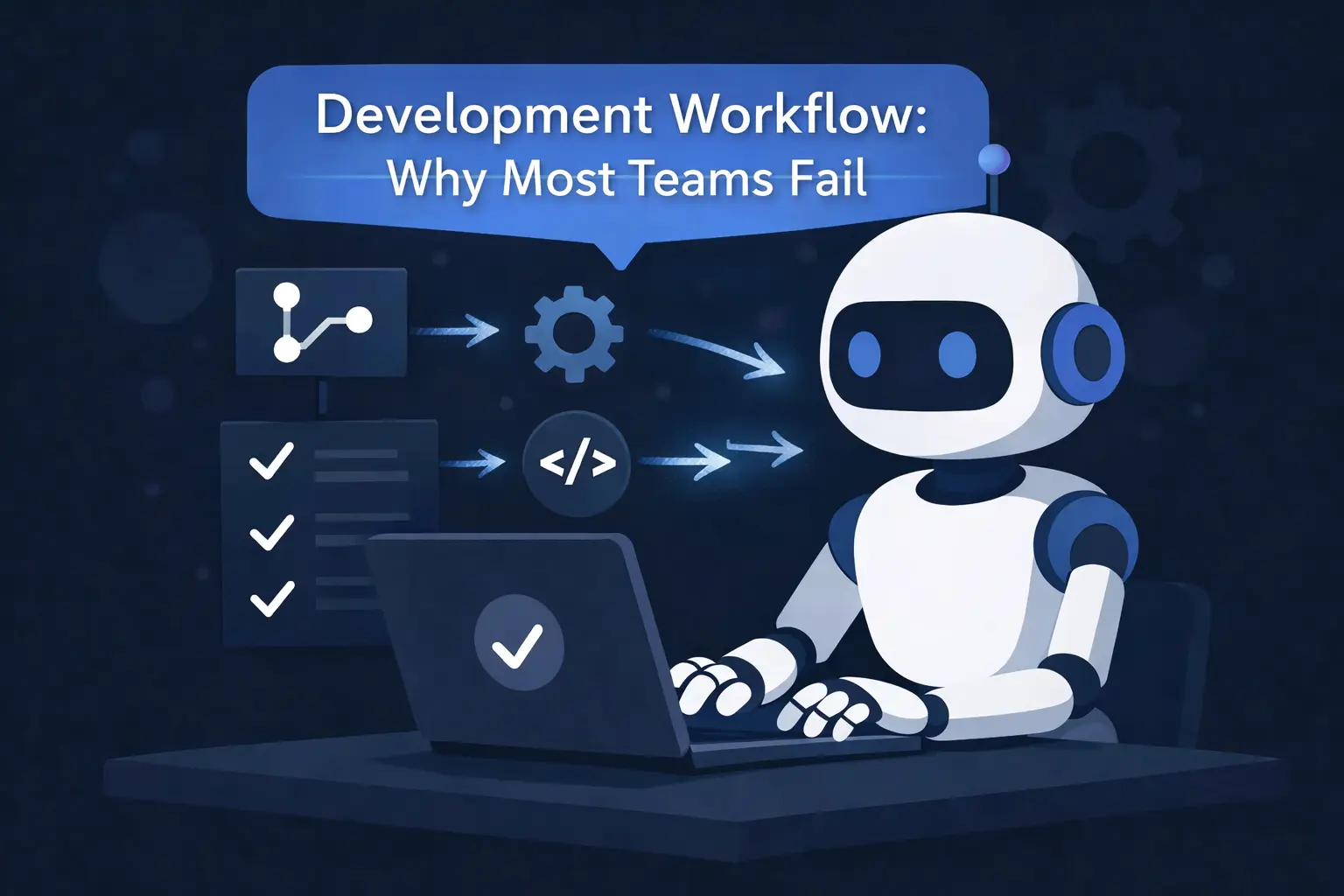
Most development workflows don’t fail loudly — and that’s exactly why a broken development workflow is so hard to notice.
They don’t collapse on day one. There is no dramatic breaking point where everyone agrees, “Yes, this process is broken.” Instead, they fail quietly, over time — through friction, fatigue, and a growing reluctance to touch the codebase.
I have seen this pattern repeat across projects of different sizes. Solo projects, small teams, early-stage MVPs, and even mature systems. The technology stack changes, the tooling evolves, but the failure modes remain surprisingly consistent.
The uncomfortable truth is this:
most workflow problems are not caused by missing tools, but by missing intent.
Let’s look at why development workflows fail — and what actually works in practice.
The Illusion of a “Good Enough” Workflow
Early in a project, almost any workflow feels acceptable.
The codebase is small. Context is fresh. Decisions are still cheap. You can fix things “later” because later feels far away. Speed matters more than structure — and that tradeoff often makes sense initially.
The problem starts when temporary decisions quietly become permanent ones.
- Feature branches live for weeks
- Hotfixes bypass review “just this once”
- Refactoring is postponed because “we’ll clean it up after launch”
- The process adapts to pressure instead of guiding it
None of these choices are catastrophic on their own. But together, they create a workflow that optimizes for short-term delivery at the expense of long-term clarity.
Eventually, every change feels risky. The team slows down — not because people are less capable, but because the system itself resists change.
That is the moment when a workflow has already failed.
Failure #1: Optimizing for Speed Instead of Predictability
One of the most common workflow mistakes is treating speed as the primary metric.
Fast merges. Fast releases. Fast decisions.
Speed is seductive, especially under deadlines. But speed without predictability creates instability. When outcomes become uncertain, developers compensate by being more cautious. Ironically, this reduces velocity over time.
A sustainable workflow prioritizes predictability over raw speed.
Predictability means:
- You know what happens when you open a pull request
- You know what checks will run
- You know how changes reach production
- You know how to roll back safely
When developers trust the process, they move faster naturally — without shortcuts.
Failure #2: Long-Lived Branches and Deferred Integration
Long-lived branches are one of the clearest signals of a failing workflow.
They usually exist for “good reasons”:
- the feature is large
- the work is complex
- merging would be painful right now
But that pain does not disappear. It compounds.
The longer a branch lives, the more context it accumulates and the more difficult integration becomes. At some point, merging feels dangerous — so it gets postponed again.
This is how teams end up with:
- massive pull requests no one wants to review
- last-minute merge conflicts before release
- features that rot before they ever ship
Short-lived branches and frequent integration are not about dogma. They are about risk management.
Small changes are easier to review, easier to test, and easier to undo.
Failure #3: Treating Code Review as a Gate Instead of a Feedback Loop
In many teams, code review slowly turns into a bureaucratic checkpoint.
Reviews become:
- defensive
- overly nitpicky
- focused on style rather than intent
Or worse, they are bypassed entirely under time pressure.
Both extremes miss the point.
A good code review process exists primarily for shared understanding, not enforcement.
It is where:
- design decisions become explicit
- knowledge spreads across the team
- potential issues are caught early
When reviews are framed as collaboration rather than approval, they strengthen both the codebase and the team. When they are treated as a hurdle, people work around them — and the workflow degrades.
Failure #4: Refactoring Is Not Part of the Workflow
Many teams claim they value clean code, yet refactoring lives in a separate mental bucket labeled “nice to have.”
This is a mistake.
If refactoring is not explicitly part of the workflow, it will always lose against feature work. There is always another deadline. Always another request.
Over time, the cost of change increases — not because developers forgot how to code, but because the system no longer supports safe modification.
Sustainable workflows treat refactoring as continuous maintenance, not a special event.
That can mean:
- applying the boy scout rule
- scheduling refactoring windows
- allowing small structural improvements alongside feature work
The exact method matters less than the principle:
change should make the system easier to work with, not harder.
About this you can find out more here: https://codecraftdiary.com/category/refactoring-patterns/
Failure #5: Automation Without Understanding
Automation is often introduced as a solution to workflow problems — and sometimes it is.
But automation without intent creates noise.
Running dozens of checks no one understands. Failing pipelines that get blindly retried. Rules enforced by tools instead of team consensus.
Automation should support human judgment, not replace it.
The most effective workflows automate:
- formatting
- linting
- basic correctness checks
They do not attempt to automate architectural thinking or design decisions. Those still require experience and context.
Good automation reduces cognitive load. Bad automation adds friction.
How to Build a Workflow That Actually Works
A sustainable development workflow does not need to be complex.
In my experience, the most resilient workflows share a few key traits:
1. Small, Reversible Changes
Changes should be easy to review and easy to revert. This lowers the psychological cost of making improvements.
2. Clear Paths From Idea to Production
Everyone should understand how code moves through the system — without relying on tribal knowledge.
3. Explicit Tradeoffs
Shortcuts are sometimes necessary, but they should be named and visible. Hidden debt is the most expensive kind.
4. Continuous Integration of Knowledge
Code reviews, documentation, and shared ownership matter more than any single tool.
5. Intentional Simplicity
The workflow exists to support development, not to impress with sophistication.
MVPs, Startups, and the “We’ll Fix It Later” Trap
MVPs are often cited as an excuse for weak workflows.
But MVP does not mean reckless.
You can move fast and maintain discipline:
- use version control properly
- keep branches short-lived
- write minimal but meaningful tests
- name things clearly
These practices do not slow you down. They preserve your ability to evolve the product once the MVP succeeds.
The real risk is not over-engineering — it is painting yourself into a corner.
Final Thoughts
A development workflow is not a static setup. It is a reflection of how a team thinks about change, risk, and responsibility.
Most workflows fail because they evolve accidentally rather than intentionally.
The good news is that you do not need a radical transformation to fix that. Small, deliberate adjustments — made consistently — are enough to shift a system from fragile to resilient.
Start simple. Be explicit. Optimize for clarity.
The rest follows naturally.